

Fundamentals · Updated Oct 13, 2026 · 12 min read
What Is AI Visibility? How It Differs From SEO (2026)
AI visibility is how often AI assistants mention your brand. See how it works, why SEO still matters, and what to track, based on 29,000+ AI citations.
 Written by Gergely Sipos
Key takeaways
- AI visibility is how often, how prominently, and how favorably AI assistants like ChatGPT, Perplexity, and Google AI Overviews mention your brand when buyers ask questions.
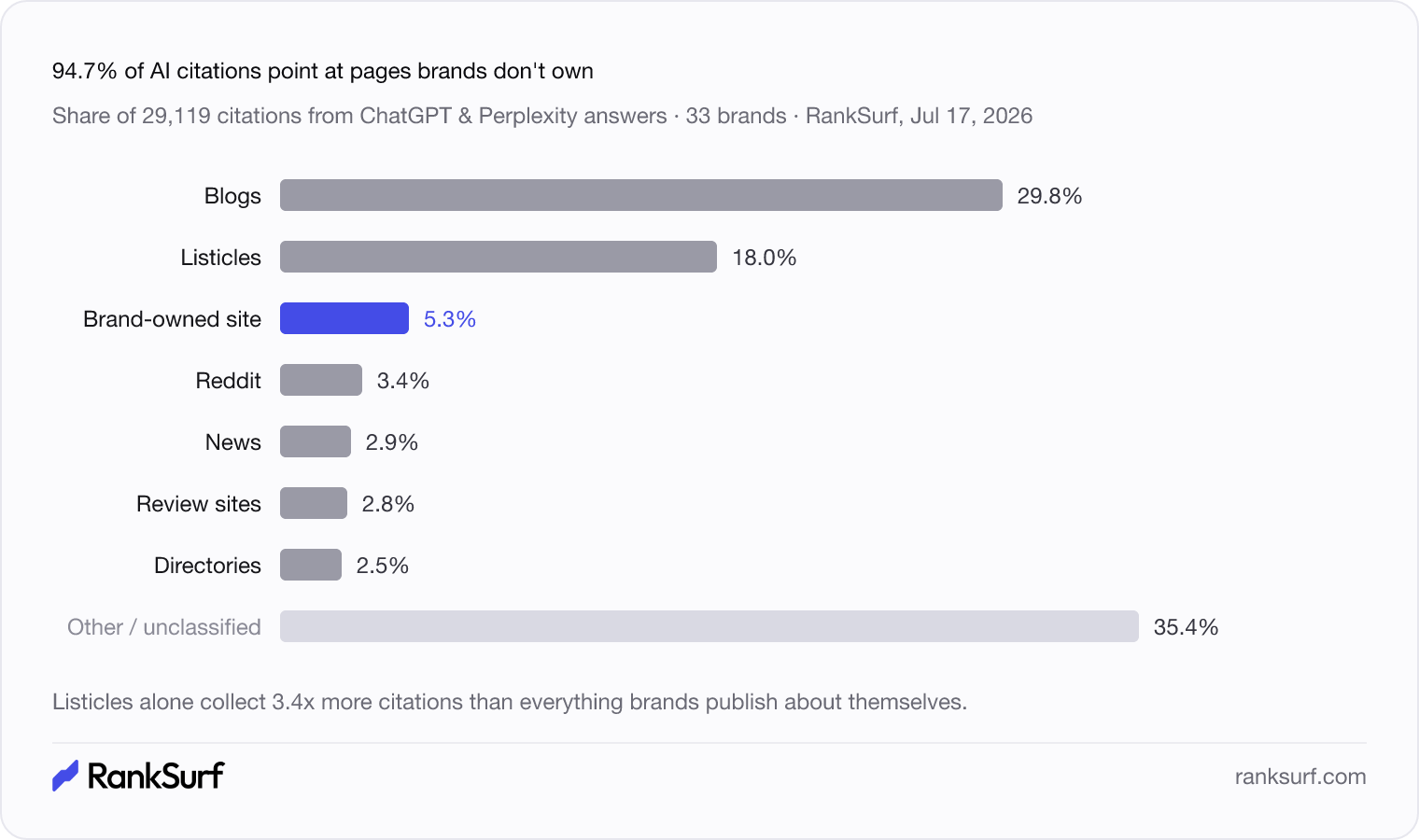
- Across 29,119 citations we extracted from ChatGPT and Perplexity answers, only 5.3% pointed at a brand's own site. Listicles alone took 18%, and reddit.com was the most-cited single domain.
- SEO is still the foundation: 76% of AI Overview citations rank in Google's top 10, and page-1 rankings correlate 0.65 with ChatGPT brand mentions.
- The layer on top of SEO is third-party presence: listicles, review sites, Reddit, and earned media decide most of what AI says about you.
- Track mention rate, share of voice, citation share, position, and sentiment per engine on a fixed prompt set. Single screenshots prove nothing.
Of the 29,119 citations we've extracted from ChatGPT and Perplexity answers, 5.3% pointed at a website the mentioned brand actually owns. The other 94.7% went to blogs, listicles, Reddit threads, review sites, and news coverage (29,119 citations across 5,600+ domains for 33 tracked brands, April 16 to July 17, 2026).
That number explains something a lot of marketing teams are living through right now. You can rank first on Google for your category and still never come up when a buyer asks ChatGPT "what's the best tool for X". AI assistants don't send readers to your site and let your homepage make the case. They read the web, weigh what everyone else says about you, and compose a recommendation on the spot.
AI visibility is the discipline of showing up well in that recommendation. This guide covers what it is, how the engines actually pick brands, where SEO fits (short version: it's the foundation, and it matters more than people think), why third-party mentions now carry so much weight, and what to measure. Our own scan data is woven in throughout, alongside third-party research we verified at the source.
What is AI visibility?
AI visibility is how often, how prominently, and how favorably AI assistants mention your brand when people ask the questions your buyers ask. It spans ChatGPT, Perplexity, Google AI Overviews, Gemini, and whatever ships next. Where SEO measures your position in a list of links, AI visibility measures your presence inside the answer itself.
In practice it breaks down into four distinct states, and brands routinely hold some without the others:
- Mentioned. The assistant names your brand in its answer.
- Cited. The assistant uses a page from your own domain as a source.
- Recommended. The assistant doesn't just name you, it puts you forward as the pick for that question.
- Described accurately. What it says about your pricing, features, and positioning is true.
Mentions and citations move independently, which surprises most teams. Across the answers we track, ChatGPT names a brand in roughly 35% of relevant answers but uses the brand's own site as a source in only 16%. We broke down that gap, engine by engine, in our study of 6,500 ChatGPT and Perplexity answers.
The reason this deserves its own discipline is scale plus zero clicks. ChatGPT reached 900 million weekly users as of February 2026 and handles over 2.5 billion prompts a day. Google's AI Overviews reach more than 2 billion monthly users. And when an AI summary appears, people mostly stop clicking: a Pew Research Center study of 68,879 real searches found users clicked a traditional result in 8% of searches with an AI summary versus 15% without, and clicked a link inside the summary in just 1% of visits. For a growing share of buyers, the AI's three-sentence description of your brand is the touchpoint. There's no second chance on your own landing page.
Is AI visibility the same as GEO, AEO, or LLMO?
They describe the same territory from different angles, and the industry hasn't settled on one term. A working taxonomy:
- AI visibility is the outcome and the measurement: how present your brand is across AI-generated answers. It's the "rankings report" of this world.
- GEO (generative engine optimization) is the practice: the content, structure, and off-site work you do to improve that outcome. The term comes from a 2023 Princeton-led paper that tested which content changes made generative engines cite a source more often.
- AEO (answer engine optimization) is mostly used interchangeably with GEO, sometimes with more emphasis on featured snippets and voice assistants.
- LLMO (large language model optimization) is the least common variant and means the same thing.
You don't need to pick a side in the naming debate. You do need to be precise about the direction: visibility is what you measure, optimization is what you do. This article is about the first, with pointers to the second.
How do AI assistants decide which brands to mention?
Two mechanisms produce every answer: what the model remembers, and what it reads live. Understanding the split tells you where your visibility actually comes from.
Model memory. During training, the model absorbs how the web talks about your category: which brands appear on best-of lists, how review sites describe them, what problems people associate them with. This knowledge is frozen at training time and shifts only when a new model version ships. If your brand barely existed in the training data, the raw model simply doesn't think of you.
Live retrieval. Most brand-relevant answers today also involve a real-time search step. Perplexity retrieves for nearly every answer. ChatGPT runs web searches for anything current or product-related. Google AI Overviews are generated on top of Google's index. The engine issues a few searches, reads the top results, and synthesizes an answer from them. Whoever those top pages say is good, the answer says is good.
Three consequences follow, and they shape everything else in this guide.
First, every engine has its own source diet. In our data, Perplexity's single most-cited domain for B2B software questions was Reddit, with 760 citations. ChatGPT cited Reddit 73 times in a comparable sample, leaning instead on TechRadar, Wikipedia, and arXiv. Optimize for one engine's diet and you can stay invisible in another's.
Second, the diets change without notice. Semrush tracked 230,000 prompts over 13 weeks in late 2025 and watched ChatGPT's Reddit citation share collapse from about 60% of responses to about 10% in six weeks, with Wikipedia falling almost as hard. A source that carries your visibility today can be demoted next month.
Third, answers are probabilistic. Ask the same question twice and you'll get different brand lists. A single screenshot of ChatGPT praising (or omitting) your brand proves almost nothing. Trends across repeated sampling are the only signal worth acting on.
How is AI visibility different from SEO?
The core shift: SEO competes for position in a list of links on a page you don't control. AI visibility competes for space inside a synthesized answer, and the raw material for that answer is the entire web's opinion of you, not just your own pages.
| SEO | AI visibility | |
|---|---|---|
| Unit of demand | Keyword | Prompt, phrased as a question |
| What users see | Ranked list of links | One synthesized answer |
| Success looks like | Position 1-3, clicks | Being named and recommended |
| Main levers | Content, links, technical health | All of that, plus third-party mentions |
| Where it's decided | Your pages | Everyone else's pages about you |
| Measurement | Stable, per-keyword rank | Probabilistic, needs repeated sampling |
The click economics have already moved. Ahrefs compared 150,000 keywords with AI Overviews against 150,000 without and found position-1 desktop click-through fell 58% between December 2023 and December 2025 when an Overview was present. Meanwhile the traffic AI assistants do send is unusually good: Adobe Analytics tracked generative AI referrals to US retail sites growing more than 1,200% between mid-2024 and February 2025, and by May 2026 Adobe's data showed AI-referred visitors converting 54% better than other sources, a full reversal from a year earlier when they converted worse.
Fewer clicks, but the visitors who do arrive have already been pre-sold by the answer. Which means the persuasion happens before anyone touches your site. That's the part SEO alone was never built to handle.
Does SEO still matter for AI visibility?
Yes, and arguably more than before, because retrieval-based engines read search indexes to build their answers. Skip the foundation and there's nothing for the AI to find.
The evidence is fairly one-directional. Ahrefs analyzed 1.9 million AI Overview citations and found 76.1% of cited pages rank in Google's top 10 for the query. Seer Interactive ran roughly 10,000 buyer questions through GPT-4o and measured a 0.65 correlation between page-1 Google rankings and brand mentions in the answers. Interestingly, the same study found the effect of backlinks on their own was weak to neutral. What predicted mentions was ranking and being talked about, not raw link counts.
Two honest nuances. Correlation isn't causation; brands that rank well are usually also the brands with the most reviews, listicle placements, and coverage, and the engines drink from all of it. And the overlap isn't total: when Semrush looked at every link inside 200,000 AI Overviews, not just the most prominent citations, only about a quarter came from top-10 organic results. Ranking is the admission ticket. It's no longer the prize.
There's also a purely mechanical dependency: AI crawlers have to be able to fetch your pages. Blocking GPTBot, PerplexityBot, or Google-Extended in robots.txt removes you from the retrieval step entirely, whatever your rankings look like. Fast, crawlable, well-structured pages that answer questions directly are as load-bearing for AI answers as they ever were for the ten blue links.
So keep the SEO program running. What changes is what you build on top of it.
Why do listicles, review sites, and Reddit matter so much now?
Because AI engines weigh third-party consensus far above self-description, and the citation data makes that concrete. In the 29,119 citations we've extracted, brand-owned domains took 5.3%. Listicles alone took 18%, more than triple everything brands published about themselves. Blogs took 29.8%. And reddit.com was the single most-cited domain in the entire sample, with 959 citations, ahead of LinkedIn, Wikipedia, and TechRadar. One community site collects more AI citations than any brand's own marketing, and more than every review site combined.
Independent studies land in the same place. Wix Studio's AI Search Lab analyzed over a million citations across ChatGPT, Google AI Mode, and Perplexity and found listicles were the single most-cited content format at 21.9%, capturing about 40% of commercial-intent citations, nearly double any other type. Muck Rack's May 2026 analysis of 25 million AI-cited links found 84% traced to earned media, with paid placements at 0.3%.
Think about what that means for a buying question like "best CRM for a 10-person sales team". The engine isn't reading your product page and taking your word for it. It's reading the three listicles that rank for the category, the G2 comparison, and a Reddit thread where practitioners argue about it. If you're absent from those pages, you're absent from the answer, no matter how good your own content is.
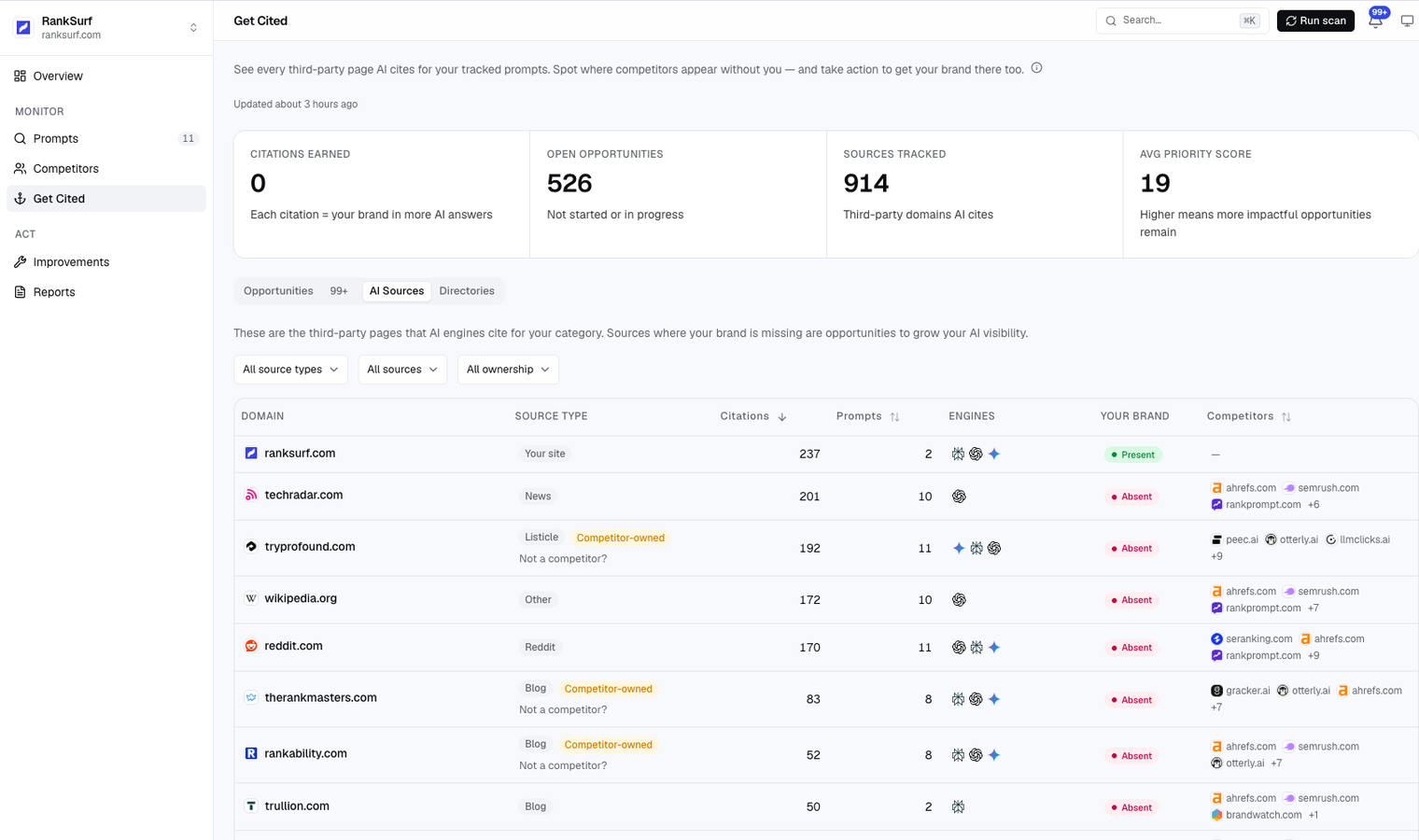
The practical upside: the set of pages that feed AI answers in your category is finite and knowable. You can enumerate the listicles, review pages, and threads the engines actually cite, check which ones include you, and work the gaps one page at a time. It's classic digital PR and review management, pointed at a new target list.
Which AI platforms should you track first?
Start with ChatGPT, Google AI Overviews, and Perplexity. Between them they cover the biggest assistant, the biggest search surface, and the most citation-transparent engine. Here's the usage picture, with dates, since these numbers move fast:
- ChatGPT: 900 million weekly active users (OpenAI, February 2026) and more than 2.5 billion prompts per day (OpenAI, July 2025). The single biggest destination where buying questions now get asked.
- Google AI Overviews: over 2 billion monthly users across 200+ countries (Alphabet Q2 2025 earnings). Not a separate app your buyers must adopt; it sits on top of the roughly 5 trillion searches Google already handles per year.
- Gemini: around 750 million monthly active users on the app as of early 2026. Growing quickly, and worth watching as Google folds it deeper into search.
- Perplexity: 780 million queries in May 2025, growing about 20% month over month per its CEO. Smaller, but heavily used for research-style buying questions, and it cites sources more visibly than anyone else.
The right tracking scope isn't "everything with a chat box". It's the engines where your buyers actually ask buying questions, sampled consistently. That's why RankSurf tracks exactly these three: ChatGPT for scale, Google AI Overviews for the search overlap, Perplexity for high-intent research. Each one answers the same question differently, so each needs its own baseline.
What should you actually measure?
Five metrics cover it, as long as you measure them per engine and over time rather than from one-off screenshots:
- Presence (mention rate). The share of your tracked prompts where the engine names your brand at all. This is the headline number, the AI-era counterpart of "do we rank".
- Share of voice. Your mentions as a share of all brand mentions in those answers. Presence without share of voice hides the fact that a competitor gets named three times as often.
- Citation share. How often your own pages appear as sources. This tells you whether your content is feeding answers or the engines are describing you entirely from third-party material.
- Position. Where you appear in the answer. Being the first name carries the recommendation; being the sixth is an also-ran.
- Sentiment and accuracy. What the answer actually says. Engines confuse pricing tiers, attribute features you don't have, and describe you in a competitor's terms. A visible brand described wrongly can be worse than an invisible one.
The states also combine in ways worth watching separately. A brand can be mentioned without being cited (the engine knows you from third-party coverage but never reads your site) or cited without being recommended, where your page is used as raw material for an answer that ends up recommending someone else. We found that pattern in 5 to 8% of cited answers and unpacked it in Cited but Not Recommended.
Whatever tool or process you use, three rules keep the data honest: fix a prompt set that mirrors real buying questions, scan it on a consistent cadence, and only ever compare trends, engine by engine. A number without a baseline is trivia.
How do you track AI visibility with RankSurf?
RankSurf automates exactly the loop above. You define the prompts your buyers ask (or generate them from your domain), and it scans them against ChatGPT, Perplexity, and Google AI Overviews on a schedule. Every answer is stored and parsed: brand mentions, position, your citations, competitor mentions, sentiment, and factual errors about your product.
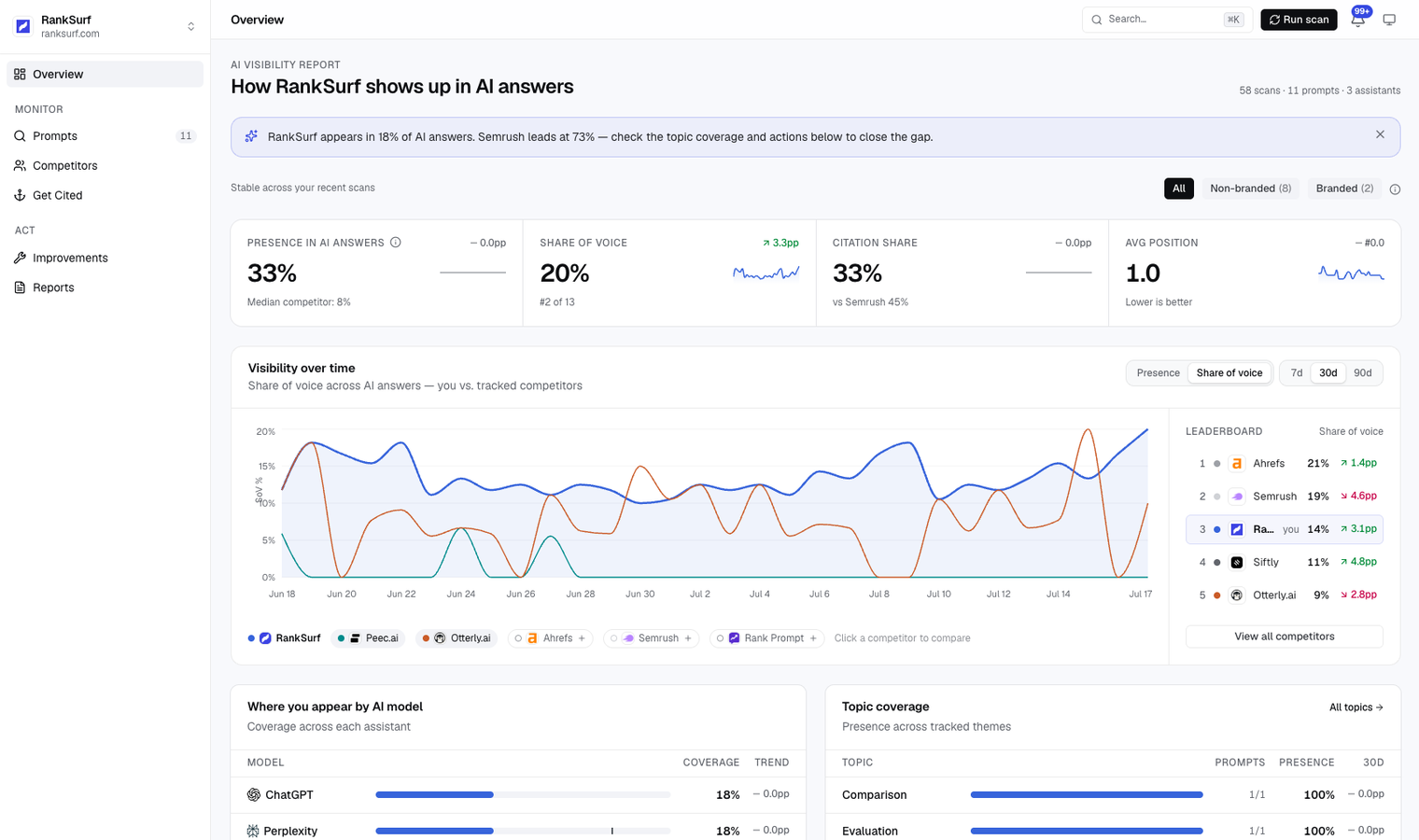
From there you get share-of-voice trends against named competitors, a per-engine presence breakdown, and a Growth Plan of Suggestions ranked by reach. Sources is the piece that operationalizes this article's core point: it shows the specific third-party pages, listicles, review sites, and Reddit threads the engines cite in your category, flags which ones already include you, and ranks them by how many of your questions and engines cite them, so you know which placement to chase first.
If you just want a first read before committing to anything, the free AI visibility scan runs 10 buying-intent prompts against ChatGPT for your domain, no signup required, and shows you where you stand next to your closest competitor.
Where to start this quarter
Three moves, in order. First, confirm the foundation: your site is fast, indexable, ranking for your core terms, and open to AI crawlers. Everything else builds on this. Second, map the third-party surface for your top 20 buying prompts and close the biggest gaps: the two listicles that every engine cites but you're missing from, the stale G2 profile, the Reddit thread where your competitor's users are the only voices. Our GEO optimization guide covers the on-page half of that work in detail. Third, put measurement on a cadence now, before you change anything. Start with the free ten-minute AI visibility audit, keep the prompts fixed, and repeat it so you can see what moves.
Rankings still matter. They've just stopped being the finish line. The finish line is what the answer says.