

Research · Updated Jul 15, 2026 · 5 min read
Cited but Not Recommended: AI Visibility’s Blind Spot
AI engines cite your page, then recommend a competitor. Cited but not recommended is the blind spot most AI visibility tracking misses. Here is how to fix it.
 Written by Gergely Sipos
Key takeaways
- A brand is cited but not recommended when an AI engine uses its page as a source but names a competitor as the pick.
- It happened in 104 answers in our sample (29 ChatGPT, 75 Perplexity), roughly 5-8% of the answers where those engines cited a brand at all.
- Recommendation and citation are separate outcomes: when ChatGPT recommends a brand, 57% of the time it cites no source for it.
- Every AI answer lands your brand in one of four states, along two axes: named in the answer, and cited as a source.
- Most tools measure one number and miss the gap. Track named-in-answer and cited-as-source separately, per engine.
In 104 answers we tracked over the past few months, an AI engine pulled a page from a brand's own website, used it to build the response, and then recommended a competitor by name. The brand's content did the work. A rival got the customer.
That outcome has a name we started using internally: cited but not recommended. It's the blind spot in how most teams measure AI visibility, and once you've seen it you can't unsee it.
What "cited but not recommended" means
A brand is cited but not recommended when an AI engine uses one of its pages as a source for an answer, yet never names the brand as an option in that answer. You informed the response. You didn't get the credit.
It's a different failure from being absent altogether, and it's easy to miss. Citation dashboards light up green because your URL shows up in the sources. Meanwhile the recommendation, the part a buyer actually acts on, goes to someone else. In our own tracking across ChatGPT and Perplexity, this happened in 29 ChatGPT answers and 75 Perplexity answers, roughly 5% to 8% of the answers where those engines cited a brand at all.
The four states of AI visibility
Every AI answer about your category drops your brand into one of four states, along two independent axes: whether the engine names you in the answer, and whether it cites your site as a source.
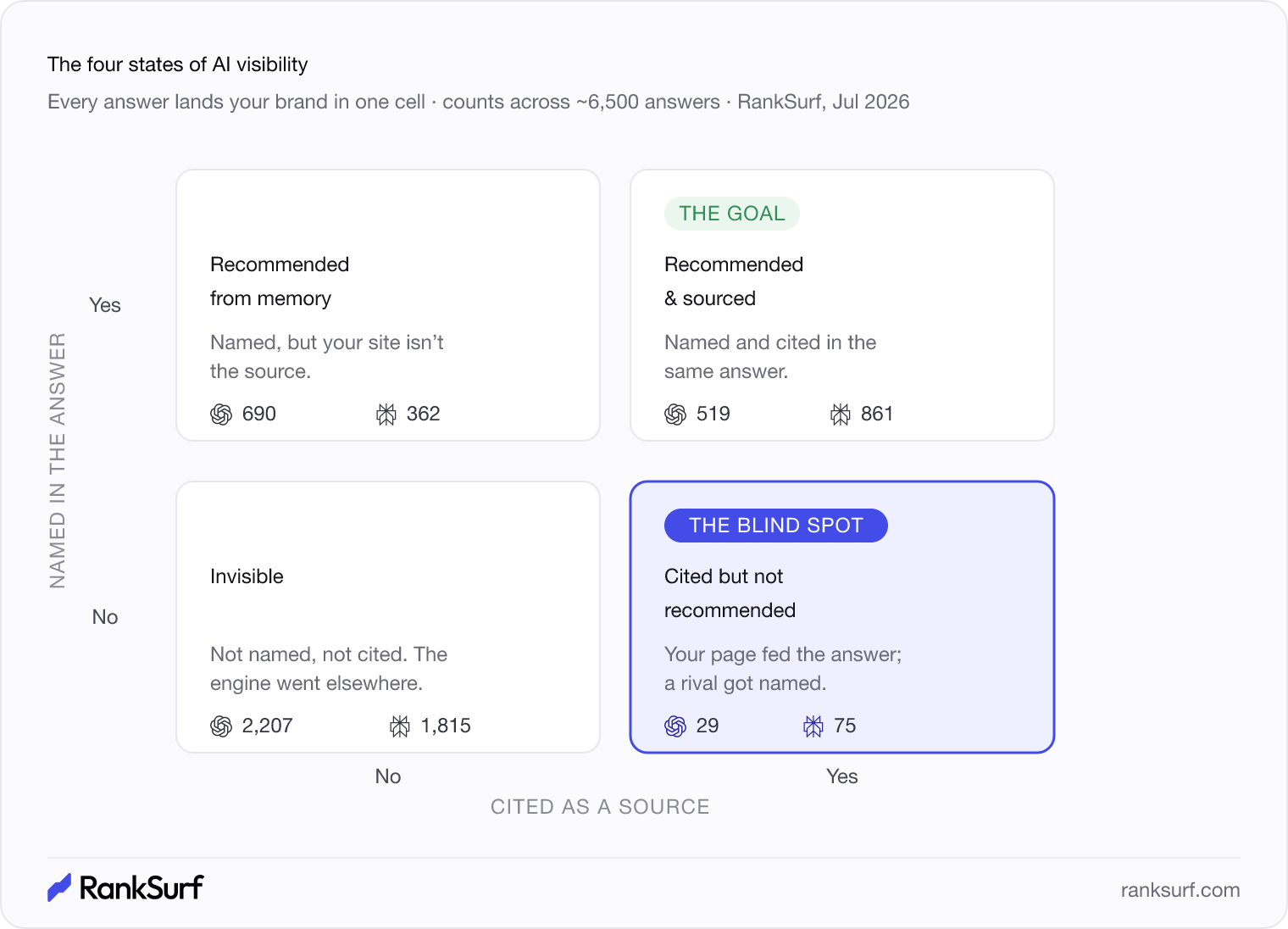
Read across the grid and the picture gets clearer. Being named and cited together is the goal, and it's the minority case: 519 answers for ChatGPT, 861 for Perplexity in our sample. Being invisible, neither named nor cited, is still the most common outcome for most brands. The two states in between are the interesting ones. Recommended from memory means the engine names you with no citation of your site. Cited but not recommended is the inverse, and the trap.
The key point is that these axes move on their own. A citation doesn't drag you into a recommendation, and a recommendation doesn't need a citation to happen.
Why citation and recommendation come apart
They come apart because AI engines answer from two places at once, their training data and live retrieval, and only one of those leaves a visible citation.
When ChatGPT names a brand from what it absorbed during training, there's no source to attach, so you get a recommendation with no citation. When it retrieves your page to ground a specific claim but hands the recommendation to a brand it already knows well, you get a citation with no recommendation. The mechanism underneath live retrieval is retrieval-augmented generation, where the model pulls in outside documents at answer time and blends them with what it already knows.
The blend is lopsided. When ChatGPT recommended a brand in our data, it cited that brand's own site only 43% of the time. The other 57% came from memory, no link attached. Perplexity leaned on live sources more, citing the recommended brand's site about 70% of the time, but even there the two outcomes don't line up cleanly.
Why most AI visibility tracking misses this
Most tools count citations, or count mentions, and report whichever one they measure as your "visibility." Neither number alone tells you which state you're in.
A brand can post a healthy citation rate and a weak recommendation rate at the same time, and a single blended score buries exactly the gap that's costing deals. If your dashboard says citations are up and revenue from AI search isn't moving, the cited-but-not-recommended state is one of the first things to check. Our study of what ChatGPT and Perplexity actually cite breaks down the source side of this in detail, including why the two engines pull from almost opposite parts of the web.
How to tell which state you're in, and what to do
Start by measuring both outcomes separately, per engine. Named-in-answer and cited-as-source are two metrics, not one, and collapsing them hides the problem.
Then act on the state you're actually in:
- Cited but not recommended. The engine trusts your content enough to quote it but doesn't yet tie your brand to the recommendation. That's a positioning and authority gap, not a content gap. Third-party corroboration, reviews, comparisons, and mentions on the sources the engine already trusts, is what closes it. Our guide to improving your AI citations covers the groundwork.
- Recommended from memory. Protect it. That standing comes from training data and the wider web's consensus about your category, and it erodes if the corroboration around you thins out.
- Invisible. This is the content and presence gap the rest of generative engine optimization addresses: publish the answers, earn the citations, and get into the retrieval pool in the first place.
Being cited is a checkpoint, not the finish
The brand that wins AI search is the one that gets named when a buyer asks what to use. That's a separate scoreboard from citations, and treating the two as the same number is how good content ends up feeding answers that recommend someone else.
We built tracking for the cited-but-not-recommended state into RankSurf because a blind spot you can't measure is one you can't fix. If you only take one thing from this: check both scoreboards, per engine, and don't call a citation a win until it comes with your name.