

Research · Updated Aug 19, 2026 · 8 min read
ChatGPT vs Perplexity Citations: A 1,750-Answer Study
A paired study of 1,750 ChatGPT and Perplexity answers shows why brand mentions, own-site citations, and branded prompts must be measured separately.
 Written by Gergely Sipos
Key takeaways
- We compared 875 matched ChatGPT and Perplexity answer pairs from 49 tracked brands, with a frozen cutoff of August 19, 2026.
- On 559 discovery prompts per engine, Perplexity cited the tracked brand's own site in 14.3% of answers versus ChatGPT's 5.5%.
- The named-rate gap was much smaller: 14.7% for Perplexity and 11.3% for ChatGPT.
- Perplexity cited a brand's site without naming the brand in 33.8% of its own-site-cited discovery answers; ChatGPT did so in 16.1%.
- Branded prompts produced named rates above 92% on both engines, so blending them with discovery prompts materially inflates visibility benchmarks.
- Perplexity returned 3.0x as many third-party citation occurrences and drew from 2.5x as many domains on the matched discovery prompts.
Perplexity cited a tracked brand's own site in 14.3% of matched discovery answers. ChatGPT did so in 5.5%. That is a 2.6x citation gap, yet the engines named the brand at much closer rates: 14.7% and 11.3%.
The difference matters because a citation and a brand mention answer separate questions. One tells you whether an engine returned a link from your site. The other tells you whether your brand appeared in what the buyer read. Our paired study found that those outcomes often split, especially in Perplexity.
We analyzed 1,750 completed ChatGPT and Perplexity answers from 49 tracked brands. Every comparison below uses matched answers for the same brand, prompt, and scan. The primary analysis uses the 1,118 answers where the prompt did not already name the brand.
What did the study measure?
We froze the dataset at 00:00 UTC on August 19, 2026. It contains the latest qualifying same-run ChatGPT and Perplexity pair for 875 brand-prompt combinations. The selected answers span April 23 through August 18, 2026.
The pairing rule is important. Both engines had to complete the same prompt in the same scan. If one engine failed, that prompt-run did not enter the comparison. We then kept one latest qualifying pair per brand and prompt, so a brand with a long scan history did not receive extra weight just for running more scans.
We recorded two independent outcomes:
- Named: the tracked brand name or a configured alias appeared in the answer and passed RankSurf's mention verification.
- Own-site cited: at least one returned source URL resolved to the tracked brand's registered domain.
"Named" records literal presence. It does not classify endorsement or purchase intent. An engine can mention a brand positively, negatively, or in passing.
The citation field records links returned with an answer. It cannot prove that one page caused the answer's wording. OpenAI's ChatGPT Search documentation distinguishes inline citations from the broader Sources panel. Perplexity's product documentation says its responses include citations and links to original sources.
For the primary comparison, we used 559 non-branded prompt pairs, or 1,118 answers. These are discovery questions where the prompt did not supply the tracked brand name or its domain token. The other 316 pairs are branded prompts and appear only as a control.
How often did each engine name and cite brands?
Perplexity's own-site citation rate was 14.3% on discovery prompts, compared with ChatGPT's 5.5%. Its named rate was only 3.4 percentage points higher: 14.7% versus 11.3%.
| Engine | Matched discovery answers | Brand named | Own site cited |
|---|---|---|---|
| ChatGPT | 559 | 63 (11.3%) | 31 (5.5%) |
| Perplexity | 559 | 82 (14.7%) | 80 (14.3%) |
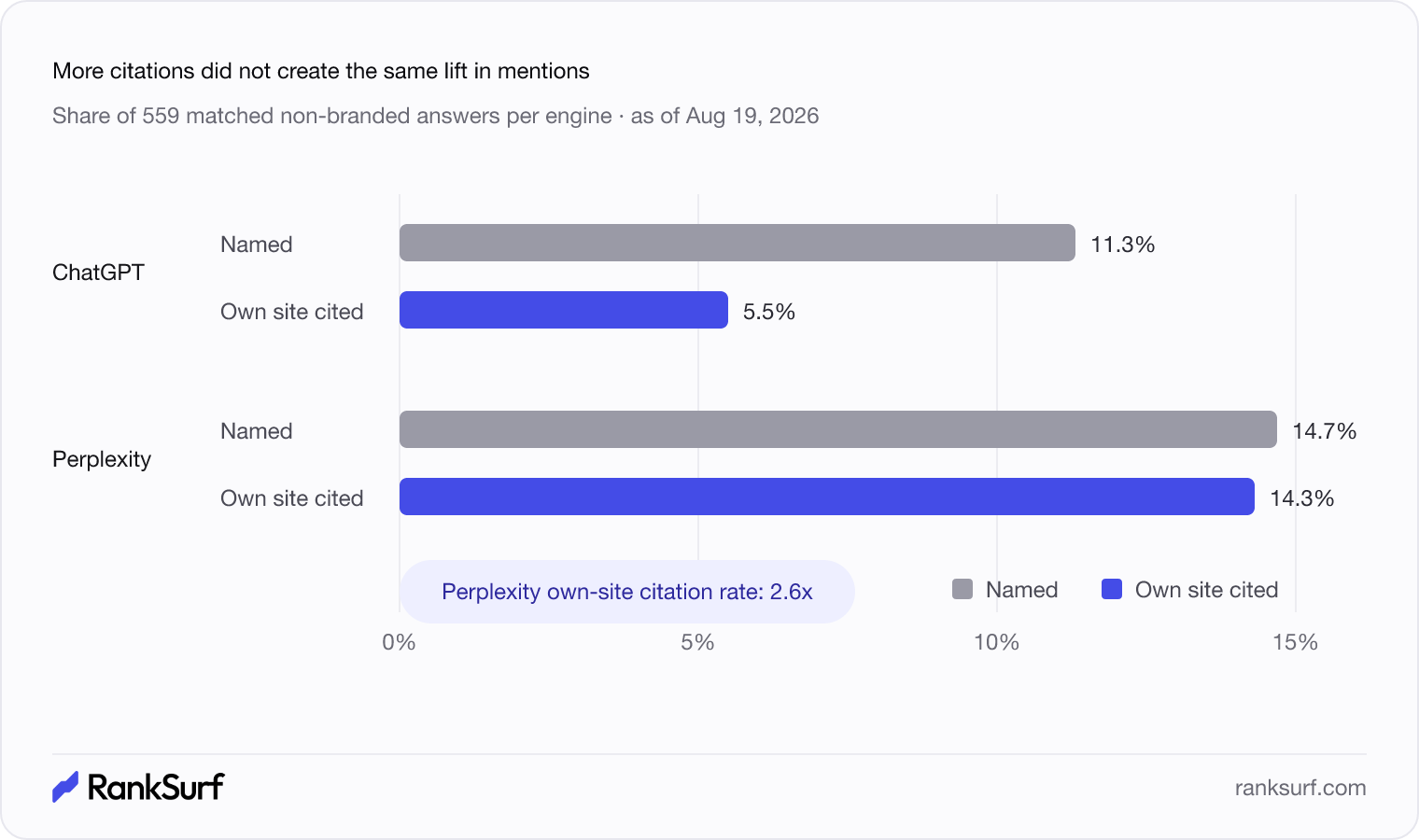
This is the study's central result. Perplexity returned far more links to brand sites, but the increase in brand presence was much smaller. A team tracking citations alone could conclude that Perplexity performance was dramatically stronger. A team tracking only mentions would see a much smaller difference.
Both views are correct. They measure different layers of the answer.
Can an engine cite your site without naming your brand?
Yes. Perplexity cited the tracked brand's site without naming the brand in 27 of its 80 own-site-cited discovery answers. That is 33.8%. ChatGPT did the same in 5 of 31 cited answers, or 16.1%.
| Answer state | ChatGPT | Perplexity |
|---|---|---|
| Named and own site cited | 26 (4.7%) | 53 (9.5%) |
| Named, own site not cited | 37 (6.6%) | 29 (5.2%) |
| Not named, own site cited | 5 (0.9%) | 27 (4.8%) |
| Neither | 491 (87.8%) | 450 (80.5%) |
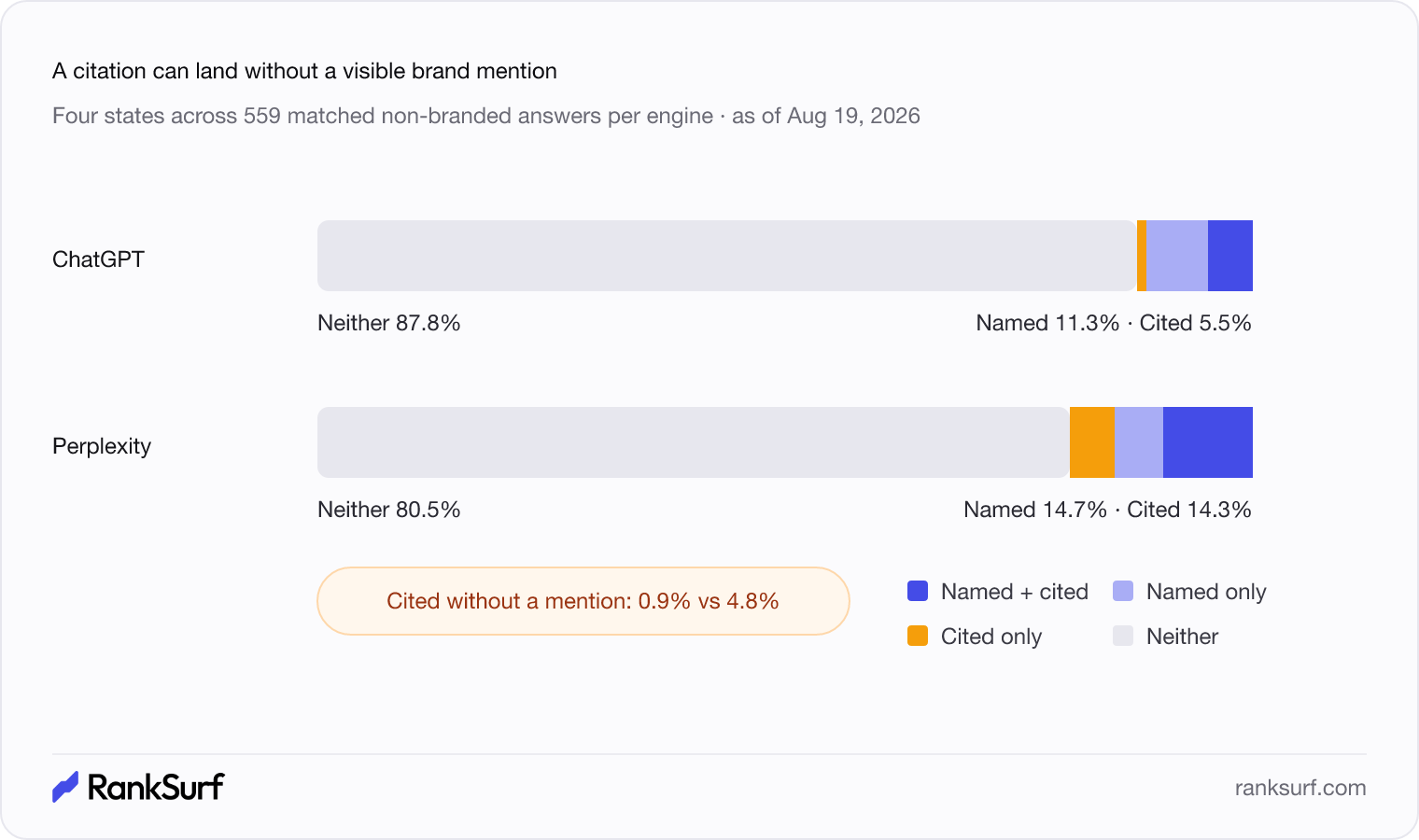
The lower-right state, cited but not named, is easy to miss. Your page contributed evidence, but the visible answer omitted your brand. That does not prove a competitor received an endorsement, and this study does not classify recommendations. It does prove that source inclusion and brand inclusion can separate inside the same answer.
This is why our four-state AI visibility framework tracks both signals. A citation gives the reader a route to the source. A mention puts the brand in the answer's prose. Neither is a complete substitute for the other.
Why do branded prompts distort visibility benchmarks?
Branded prompts named the tracked brand in 92.1% of ChatGPT answers and 93.0% of Perplexity answers. On discovery prompts, those rates fell to 11.3% and 14.7%.
Mixing the two populations would raise the headline named rate to 40.5% for ChatGPT and 43.0% for Perplexity. Those blended numbers are mathematically correct, but they answer an easier question: can the engine repeat a brand the user already supplied?
A useful visibility benchmark should print its prompt mix. If a report does not separate branded from non-branded questions, a change in the mix can look like performance growth even when discovery visibility did not move.
Our AI visibility measurement guide explains how to keep the prompt set and denominator stable when tracking changes over time.
Which third-party sources did the engines cite?
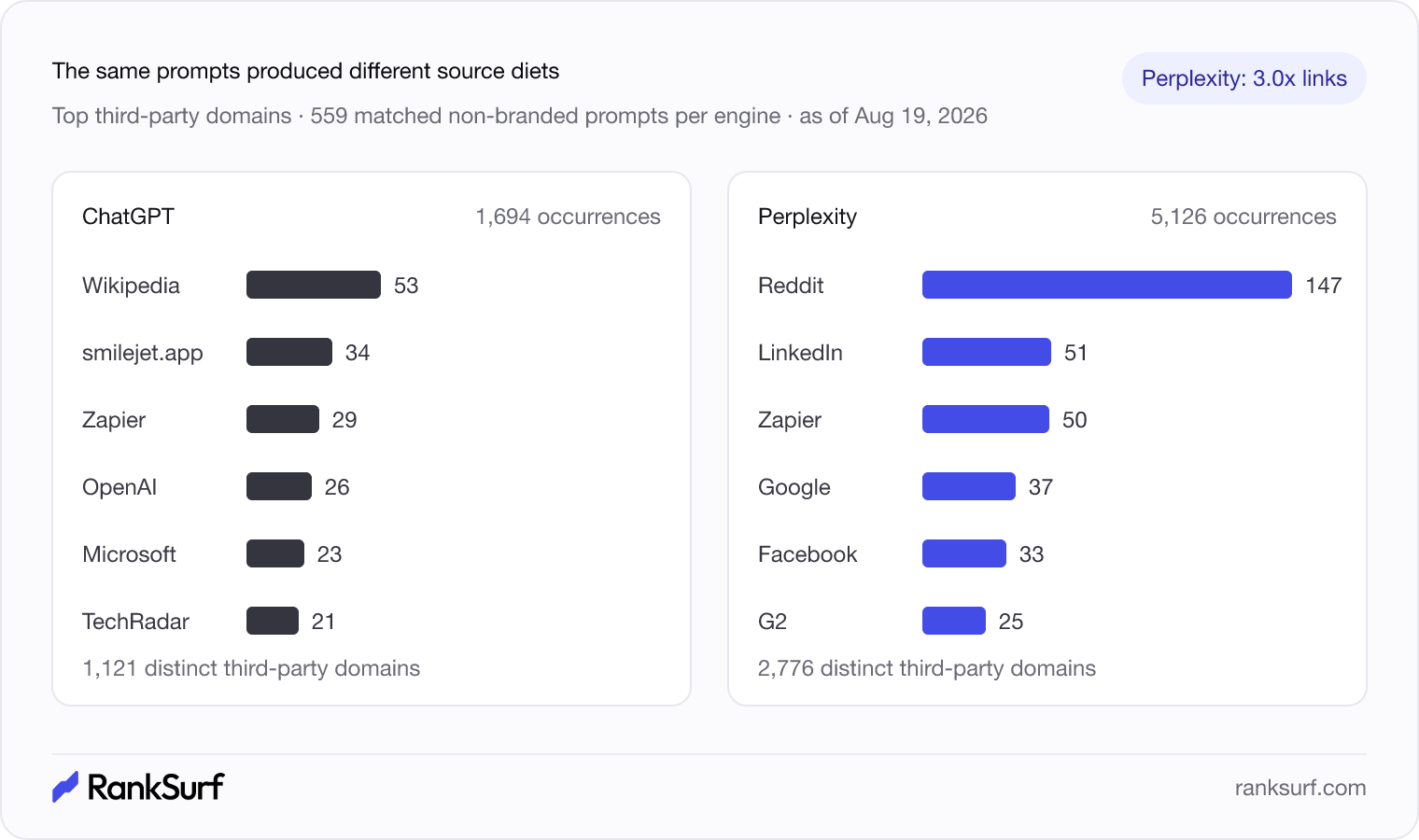
The matched discovery answers also showed different retrieval patterns. Perplexity returned 5,126 distinct URL-answer citation occurrences across 2,776 third-party domains. ChatGPT returned 1,694 occurrences across 1,121 domains.
Perplexity therefore produced 3.0x as many third-party citation occurrences and drew from 2.5x as many domains on the same 559 prompts. Its top ten domains accounted for 8.6% of occurrences, compared with 13.8% for ChatGPT. In this sample, Perplexity's source set was broader and less concentrated.
The leading domains were also different:
| Rank | ChatGPT | Citations | Perplexity | Citations |
|---|---|---|---|---|
| 1 | wikipedia.org | 53 | reddit.com | 147 |
| 2 | smilejet.app | 34 | linkedin.com | 51 |
| 3 | zapier.com | 29 | zapier.com | 50 |
| 4 | openai.com | 26 | google.com | 37 |
| 5 | microsoft.com | 23 | facebook.com | 33 |
| 6 | techradar.com | 21 | g2.com | 25 |
These counts cover third-party citations only. We excluded the tracked brand's own domain and configured competitor domains from the source ranking. One occurrence means one distinct cited URL in one answer, so duplicate copies of the same URL inside an answer count once.
Use these global rankings as context. Start your source plan with the domains already appearing for your actual buyer questions. Our Perplexity visibility guide covers how to map those prompt-level sources without turning community participation into spam.
What should a marketing team do with these findings?
Track named rate and own-site citation rate separately. A rising citation rate with a flat named rate means more answers link to your site without a matching increase in visible brand presence. A rising named rate with flat citations means more answers include the brand without adding links to its own pages.
Separate branded and discovery prompts in every dashboard. Branded prompts are useful for checking factual accuracy and brand narrative. Discovery prompts measure whether an unfamiliar buyer can encounter you. Combining them hides the harder result.
Compare engines on matched prompts. Perplexity returns far more citations per answer, so raw citation totals will naturally favor it. Rates and paired samples make the comparison interpretable.
Finally, work from the sources in your own answer set. The global top domains are useful context, but the page that matters is the one repeatedly cited for the exact questions your buyer asks. Build or improve your own answer page when the engine cites weak material. Pursue editorial inclusion when trusted third-party pages dominate. Join community discussions only when you can contribute something useful.
Download the aggregate data
The public files contain no customer names, tracked domains, prompt text, answer text, or internal IDs.
- Download the paired citation and mention benchmark CSV
- Download the top third-party source domains CSV
The first file contains all, non-branded, and branded results for both engines. The source-domain file contains the top ten domains per engine for the primary non-branded sample.
Methodology and limitations
The frozen cutoff was August 19, 2026 at 00:00 UTC. We included completed non-preview runs only. Prompts archived before the cutoff were excluded. If a prompt had been edited, only answers generated after the edit qualified. Both engines had to complete the same prompt in the same run, and the latest qualifying pair was retained.
The dataset is a convenience sample of RankSurf projects, not a random census of the web. Markets, languages, categories, and prompt counts vary by brand. Brands with more tracked prompts contribute more rows, although retaining one answer per brand-prompt-engine prevents long-running accounts from dominating through repeated scans. Engine behavior and source retrieval can also change after the cutoff.
The full reproducible definition, denominators, query rules, checksums, and field definitions are recorded with the dataset release. Every percentage in the public benchmark prints its count and denominator.
Cite this study
How to cite this study: Gergely Sipos, "ChatGPT vs Perplexity Citations: A 1,750-Answer Study," RankSurf, August 19, 2026. ranksurf.com/blog/what-chatgpt-and-perplexity-cite
Publisher: RankSurf
Author: Gergely Sipos
Originally published: July 15, 2026
Last updated: August 19, 2026
Dataset version: 1.0
Canonical URL: https://ranksurf.com/blog/what-chatgpt-and-perplexity-cite
For press or editorial use, the three figures may be reused with attribution to RankSurf and a link to the canonical study. Verified short findings:
- Perplexity cited the tracked brand's own site in 14.3% of matched discovery answers, versus ChatGPT's 5.5%.
- Perplexity returned 3.0x as many third-party citation occurrences across the same prompts.
- A third of Perplexity's own-site-cited discovery answers did not name the tracked brand.
- Branded prompts produced named rates above 92% on both engines, versus 11.3% and 14.7% on discovery prompts.
Update log
- August 19, 2026, version 1.0: Replaced the earlier unmatched historical analysis with a frozen same-run paired dataset; separated branded and discovery prompts; added public aggregate CSVs, explicit denominators, reproducible definitions, and a four-state citation-mention matrix.