

Comparisons · Updated Jul 9, 2026 · 10 min read
The 10 Best AI Visibility Tools in 2026 (Ranked & Compared)
A criteria-based comparison of the best AI visibility and GEO tools in 2026: what each does best, who it's for, and how to pick the right one to track and fix how ChatGPT, Perplexity, and Google AI Overviews talk about your brand.
 Written by Gergely Sipos
Key takeaways
- AI visibility tools track how ChatGPT, Perplexity, and Google AI Overviews mention, cite, and describe your brand. It's the new layer sitting under SEO.
- We scored 10 tools on engine coverage, prompt tracking, citation traceability, competitor benchmarking, actionability, accuracy, and pricing.
- RankSurf ranks #1 for closing the loop: an on-site page-level fix list (verified on re-crawl) plus an off-site map of which third-party pages to get cited on. Most tools only measure.
- Want the broadest enterprise engine coverage? Look at Evertune or Profound. Cheapest entry is Otterly. Already running an SEO stack? Semrush or Ahrefs.
- Most tools stop at measuring. Turning findings into actual fixes is the hardest and most valuable capability, and it's the one to weight.
Your brand already shows up in ChatGPT, Perplexity, and Google's AI Overviews. The real question is whether you know what they say about you. And whether you're in the answer at all when a buyer asks who to pick.
AI visibility tools close that gap. They show you how AI engines mention, cite, and describe your brand, track it against your competitors, and the good ones help you fix what's broken. We tested the leading options and ranked the ten worth your time in 2026.
What is AI visibility (and GEO)?
AI visibility is how often, and how accurately, your brand shows up in the answers AI engines generate. Generative Engine Optimization (GEO) is the practice of improving that. Think of it as SEO's successor. Instead of ranking blue links, you're competing to be named and cited inside a synthesized answer the user often never clicks past.
Most tools measure five things:
- Mentions. Are you named in the answer at all?
- Citations. Is a page linked as a source for that answer?
- Share of voice, meaning your presence against named competitors.
- Sentiment and accuracy. Is what's said about you correct and current?
- Prompt coverage, or which questions you show up for and which you miss.
Measuring is the easy part. The hard part, the part that moves revenue, is knowing what to change so the next answer includes you. That's where these tools quietly split.
How we evaluated these tools
We scored each tool on seven criteria:
- AI engine coverage. Which answer engines it tracks.
- Prompt tracking depth, or how well you can curate and manage the questions you monitor.
- Citation traceability. Does it separate "mentioned" from "cited as a source," with the source URL?
- Competitor benchmarking, meaning cross-engine share of voice against named rivals.
- Actionability, the fix bridge. Does it turn findings into concrete fixes, or stop at a score?
- Accuracy and hallucination detection. Flagging wrong or outdated claims about your brand.
- Pricing transparency and fit.
Pricing below is current as of July 2026. Vendors change plans often, so confirm the latest figures on the vendor's own site before you buy.
At a glance: the 10 tools compared
| Tool | Best for | Engines tracked | Standout | Starting price |
|---|---|---|---|---|
| RankSurf | Monitoring and fixing in one place | ChatGPT, Perplexity, Google AI Overviews | On-site page-level fix list plus off-site "get cited here" map, both verified on re-crawl | $89/mo (7-day trial plus free scan) |
| Profound | Enterprise AEO with automation | ChatGPT, Perplexity, AIO, Gemini, Copilot, more | "Agents" plus prompt-volume analytics | $99/mo |
| Otterly.AI | Budget-friendly starting point | ChatGPT, AIO, Copilot, Perplexity | Full feature set at a low entry price | $29/mo |
| Peec AI | Agencies wanting a GEO roadmap | ChatGPT, Perplexity, Gemini, more | "Actions" opportunity clusters | See site |
| AthenaHQ | Revenue attribution | ChatGPT, Perplexity, AIO, Gemini, Claude | GA4/GSC/Shopify attribution plus free tier | Free / $295/mo |
| Evertune | Enterprise, real-user data | Up to 11 engines | 25M-person AI-user panel | $800/mo |
| Semrush AI Toolkit | Existing Semrush/SEO teams | ChatGPT, Google AI, Gemini, Perplexity | SEO and AI data in one account | $99/mo per domain |
| Writesonic | Content teams | ChatGPT, Gemini, AIO (more on Enterprise) | GEO bundled with AI content tools | $79/mo |
| Scrunch AI | Serving AI crawlers | ChatGPT, Claude, Gemini, Perplexity, AIO, more | Structured "Agent Experience" layer | $250/mo |
| Ahrefs Brand Radar | Ahrefs ecosystem users | AIO, AI Mode, ChatGPT, Perplexity, Gemini | Prompt corpus from Ahrefs' data | With Ahrefs plans |
The 10 best AI visibility tools in 2026
1. RankSurf, best for monitoring and fixing in one place
Pick RankSurf if a score isn't enough. You want to know exactly what to change, on your site and off it, to win an AI answer back.
Most tools here are excellent at telling you where you're losing. RankSurf is built around the next step: what to do about it. It tracks how ChatGPT, Perplexity, and Google AI Overviews describe and cite you, then splits that into two fix tracks.
On-site: fix your own pages. RankSurf produces a page-level fix list. The specific pages on your site, and the specific changes to them, most likely to move an AI answer in your favor. It also scores brand accuracy, a truth check for wrong or outdated claims engines repeat about you. After you ship a change, it re-crawls to verify whether the fix actually landed. You get a before and after, not a guess.
Off-site: get cited where you don't own the page. This is the part most tools skip. AI engines don't only cite your website. They lean heavily on third-party pages: listicles, review sites, Reddit threads, industry roundups, comparison articles. RankSurf shows you which of those sources the engines actually cite for your category, and where you need to be present to earn a citation. It's an executable "barnacle GEO" strategy. Instead of guessing, you get a ranked map of the specific off-site placements worth chasing.
That combination is the real differentiator. Almost every tool here measures your visibility. RankSurf tells you what to fix on your pages and where to show up off-site to earn the citations that feed the answer, then confirms your on-site work took.
Engines: ChatGPT, Perplexity, Google AI Overviews. Best for: teams that want to close the loop from insight to fix, on-site and off. Honest limitation: RankSurf deliberately focuses on the three engines that dominate buying-intent answers today rather than spreading across ten-plus. If you need Gemini, Copilot, Grok, or Meta AI coverage right now, a broader tool below (Evertune or Profound) fits better. Try it: a free AI Visibility Scan, no signup, or a 7-day trial from $89/mo.
2. Profound, best for enterprise AEO programs
Profound pairs cross-engine monitoring with automation: "Agents" that analyze prompts and draft content, and "Prompt Volumes" that estimate what people actually ask AI at scale. Engine breadth is plan-gated. The entry tier tracks ChatGPT only, with higher tiers adding up to around ten. Best for: mid-market and enterprise teams with dedicated AEO budget. Consider it over RankSurf if you need the widest engine surface and in-house automation more than a guided fix workflow. Pricing: from $99/mo (annual).
3. Otterly.AI, best budget-friendly entry
Otterly gives you a genuinely low-cost on-ramp with daily tracking, GEO URL audits, and a fairly complete feature set even on lower tiers. Some engines (Gemini, AI Mode, Claude) are paid add-ons, and prompt caps run tight at the bottom tier. Best for: SMBs, agencies, and SEO teams starting AI-visibility work. Consider it if budget is the hard constraint and you want to prove the category out before committing. Pricing: from $29/mo.
4. Peec AI, best for a prioritized GEO roadmap
Peec tracks visibility, rank, and sentiment using simulated browser sessions, and its "Actions" feature clusters content-gap opportunities into a scored roadmap. Its per-project, unlimited-user model reads agency-friendly. Best for: marketing teams and agencies. Limitation: self-serve tiers cap engines and projects. Pricing: self-serve tiers, so check Peec's site for current figures.
5. AthenaHQ, best for revenue attribution
AthenaHQ connects AI visibility to revenue through GA4, GSC, and Shopify integrations, and its Action Center maps gaps to the exact cited passages. There's a free tier, and its "Ask Athena" copilot is grounded in your own visibility data. Best for: mid-market teams and agencies that need attribution. Consider it if tying AI visibility to pipeline and revenue is your top reporting requirement. Limitation: credit metering means cost scales with tracking depth. Pricing: free tier, then $295/mo.
6. Evertune, best for enterprise with real-user data
Evertune layers a roughly 25-million-person panel of real AI-app users on top of API sampling. That gives it consumer-grade data most competitors lack, plus paid placements inside AI conversations. It tracks up to eleven engines. Best for: enterprise and large agencies. Consider it over RankSurf if you need the broadest engine coverage and real-user behavioral data at enterprise scale. Limitation: no self-serve free trial, and it's built for larger budgets. Pricing: Pro from $800/mo.
7. Semrush AI Toolkit, best for existing SEO teams
If you already live in Semrush, its AI Toolkit puts classic SEO and AI-search data side by side, with a dedicated AI-search site audit. Best for: current Semrush users and SEO teams. Consider it if you'd rather add AI data to a suite you already own than run a second tool. Limitation: the standalone base plan covers one domain and a small prompt set. Pricing: from $99/mo per domain.
8. Writesonic, best for content teams
Writesonic bundles GEO monitoring and an "Action Center" fix workflow inside its AI content platform, so you can research, write, and track in one place. Perplexity and Claude coverage unlock only at the Enterprise tier. Best for: content and brand marketing teams. Consider it if your bottleneck is producing the content, not diagnosing where to place it. Pricing: from $79/mo.
9. Scrunch AI, best for actively serving AI crawlers
Scrunch goes beyond measuring. It can serve AI agents a structured, machine-readable content layer (its "Agent Experience Platform"), alongside crawlability audits and citation tracking. Best for: mid-market and enterprise brands. Limitation: the agent-experience layer is newer and reported as limited-availability, and cost scales with volume. Pricing: from $250/mo, with a 7-day trial.
10. Ahrefs Brand Radar, best for the Ahrefs ecosystem
Brand Radar reuses Ahrefs' keyword and "People Also Ask" corpus to model real prompts and track brand mentions across engines, tied to your existing web data. Best for: SEO teams already using Ahrefs. Consider it if you're already invested in Ahrefs and want AI mentions next to your backlink and keyword data. Limitation: lighter on AEO-specific fix workflows than GEO-native tools. Pricing: included with Ahrefs plans, so check Ahrefs for standalone pricing.
On-site vs off-site GEO: two jobs, not one
Most buyers assume winning AI answers is about fixing their own website. That's only half the game.
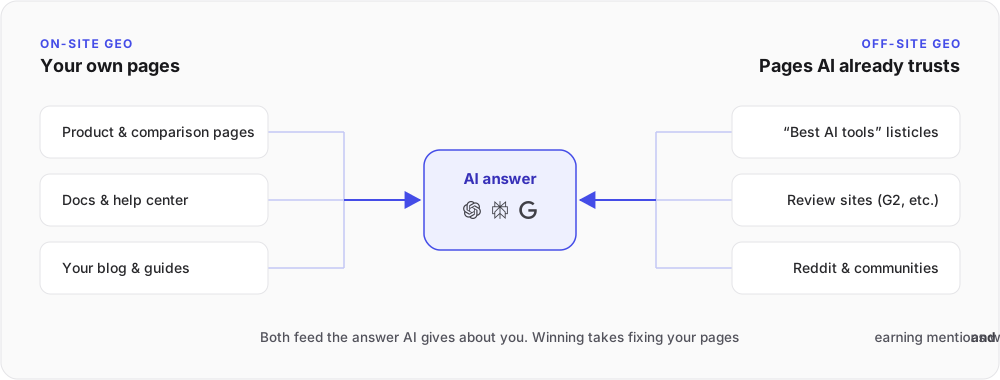
On-site GEO is getting your own pages cited. You make them clear, structured, and authoritative enough that an engine pulls from them and names you. This is the part you fully control: product pages, docs, comparison pages, blog.
Off-site GEO is earning mentions on the third-party pages the engines already trust. When ChatGPT recommends a tool, it's often synthesizing from a "best X tools" listicle, a Reddit thread, a review site, or an industry roundup. Pages you don't own. If your competitors sit on those pages and you don't, no amount of on-site polish fully closes the gap. Getting placed, mentioned, or reviewed there goes by the name "barnacle GEO": attaching yourself to the high-authority surfaces the engines cite.
The practical takeaway is to audit both. Ask a tool not only "which of my pages should I fix?" but "which pages I don't own are feeding these answers, and how do I get onto them?" Tools that only score your domain answer the first question. RankSurf answers both, and verifies your on-site changes actually moved the needle.
How to choose the right AI visibility tool
Start with the job, not the feature list.
- Monitor and fix in one workflow, on-site and off: RankSurf. The whole point is turning findings into page-level fixes plus off-site placement targets, then proving the on-site ones worked.
- Enterprise that needs the widest engine coverage: Evertune or Profound.
- Tight budget, or just getting started: Otterly.
- Already own an SEO suite: Semrush's AI Toolkit or Ahrefs Brand Radar.
- Revenue attribution: AthenaHQ.
- Agency reporting to clients: Peec or Otterly, for the per-project economics.
The most common mistake is buying a score instead of a workflow. A dashboard that tells you you're losing but not what to change. Weight actionability heavily, because it's the criterion most tools quietly fail. And make sure the workflow covers off-site placements, not just your own domain.
The verdict
Every tool here is a legitimate choice for the right team. We rank RankSurf #1 because it's built around the hardest and most valuable step: turning "ChatGPT recommends your competitor" into a specific, verifiable fix, on your own pages and on the third-party pages the engines actually cite, while still covering the answer engines that matter most for buying decisions. If your priority is raw engine breadth, or you're already deep in an existing suite, the alternatives above may serve you better. That's exactly how it should be.
The fastest way to see where you stand is to run a free scan. No signup required.