

Fundamentals · Updated Aug 18, 2026 · 7 min read
How to Run an AI Visibility Audit (Free, in 10 Minutes)
Run a free AI visibility audit in 10 minutes: ten buying-intent prompts, a three-engine spot-check, and a scoring rubric benchmarked on 9,118 AI answers.
 Written by Gergely Sipos
Key takeaways
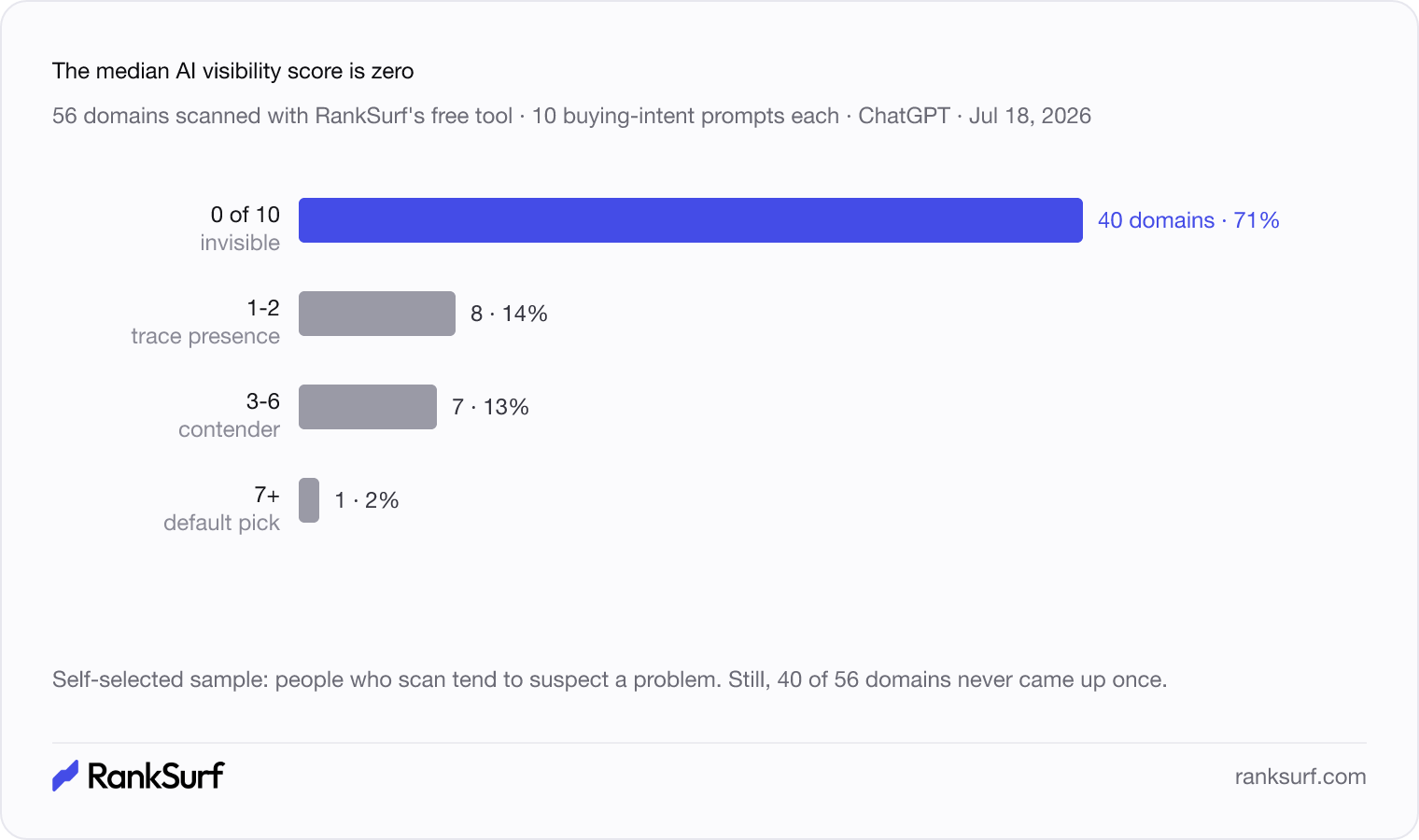
- Most brands are less visible than they assume: of 56 domains scanned with our free tool, 71% were mentioned in zero of ten buying-intent ChatGPT prompts. The median score was 0/10.
- The 10-minute method: write ten buying-intent prompts (category, problem, comparison, qualifier), run them in a fresh ChatGPT session, and record mention, position, citation, and accuracy.
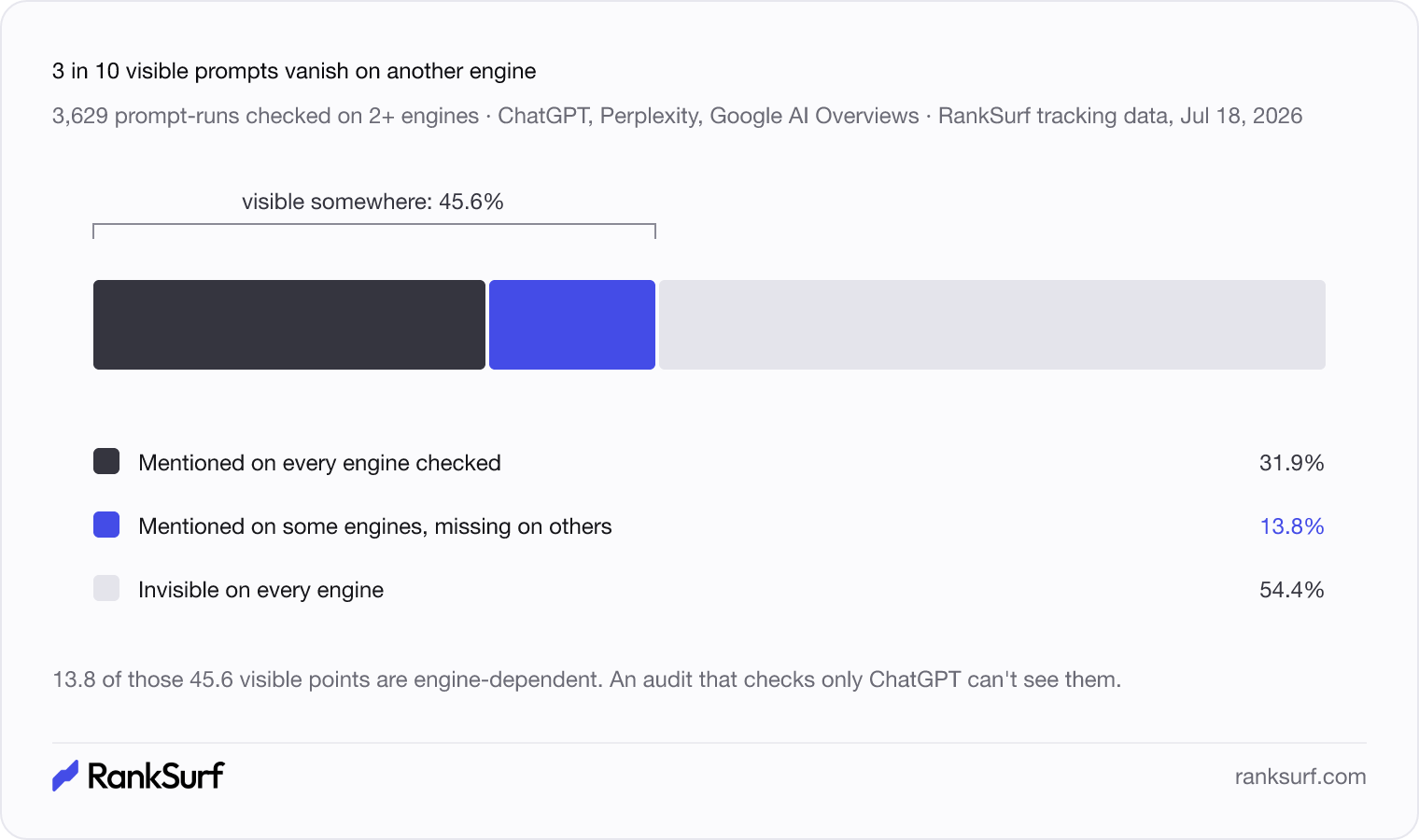
- Spot-check Perplexity and Google AI Overviews too: in our tracking data, roughly 3 in 10 prompts visible on one engine are invisible on another.
- Score = mentions out of 10. Benchmarks: 0 is invisible (and the median), 1-2 trace presence, 3-5 contender, 6+ default pick (1 domain in 56).
- Re-run the same ten prompts every 30 days to see trend. A free automated version runs the same audit in about 60 seconds.
We looked at the first 56 domains people checked with our free AI visibility scanner. 40 of them, 71%, were mentioned in zero of the ten buying-intent prompts we ran through ChatGPT. The median score was 0 out of 10. Only one domain out of 56 scored 7 or higher. Most companies assume AI engines know who they are. The data says otherwise, and finding out where you stand takes about ten minutes and costs nothing.
This guide walks through the exact audit: ten prompts, three engines, a scoring rubric, and benchmarks from 9,118 real AI answers so you know whether your result is normal or a problem.
What is an AI visibility audit?
An AI visibility audit measures whether AI assistants mention, recommend, or cite your brand when a potential customer asks a buying question. You run a fixed set of prompts through ChatGPT, Perplexity, and Google AI Overviews, record what comes back, and score the result.
It answers four questions a traditional SEO rank report can't:
- Presence. When someone asks "best [your category] for [your customer]", do you appear at all?
- Position. Are you the first name, or the seventh?
- Citation. Does the answer link your site as a source, or describe you from stale third-party data?
- Accuracy. Is what the AI says about you actually true?
If you want the deeper background on how this differs from SEO, we cover it in what AI visibility is and how it's measured. For a recurring program, the complete AI visibility measurement guide covers metrics, per-engine sampling, dashboards, and reporting. This article is the hands-on version: you'll have a score before your coffee gets cold.
Why audit your AI visibility now?
Because the buying journey has already moved. ChatGPT passed 900 million weekly active users in February 2026. Google says AI Overviews reaches over 2.5 billion monthly users as of I/O 2026. Those aren't fringe surfaces anymore. They're the front door.
And AI answers replace clicks. Pew Research found that when an AI summary appears, users click a traditional result in just 8% of visits, versus 15% without one (68,879 tracked searches, March 2025). By early 2026, 68% of US Google searches ended without any click at all, per SparkToro's analysis of Similarweb clickstream data. If the answer doesn't include you, there is no page two to rescue you.
The buyers who remain are worth more. HubSpot surveyed 3,000+ CRM purchase decision-makers in January 2026: 42% used AI search during evaluation, and those buyers were 36% more likely to purchase than buyers who didn't. An AI recommendation lands right at the decision moment.
The 10-minute audit, step by step
You need a browser, a spreadsheet (or a notes app), and a timer. No tools, no signup.
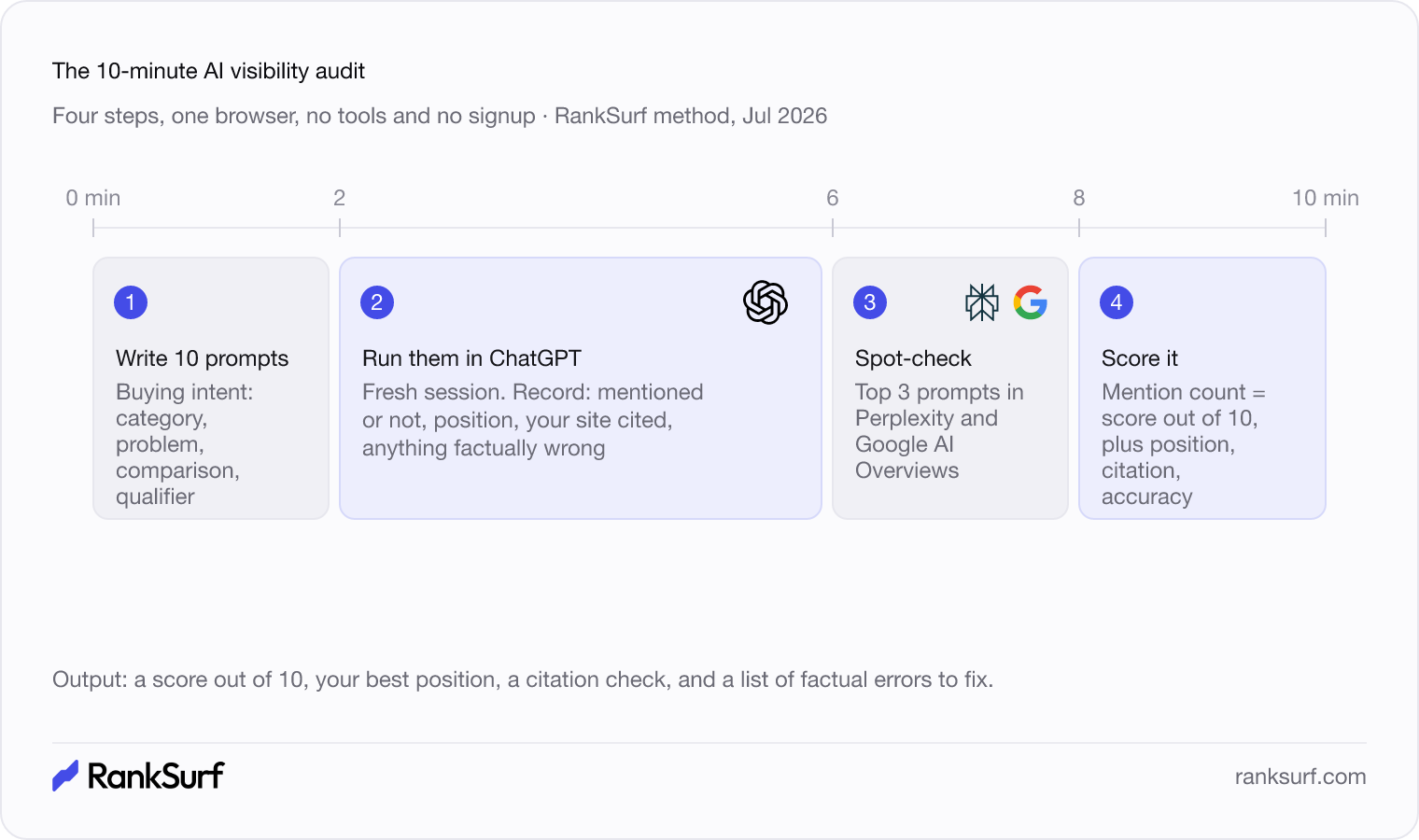
Minutes 0-2: write ten buying-intent prompts
Write the questions your next customer would ask an AI assistant, not the questions you'd like them to ask. The mix that works:
- 4 category prompts: "best [category] for [ICP]", "recommend a [category] tool for [use case]"
- 2 problem prompts: "how do I [job to be done]" where your product is a legitimate answer
- 2 comparison prompts: "[competitor] alternatives", "[competitor A] vs [competitor B]"
- 1 qualifier prompt: "[category] under [price] / for [company size] / that integrates with [tool]"
- 1 brand check: "is [your brand] good for [use case]?"
Concrete example for a hypothetical email tool: "best cold email tool for small agencies", "how do I warm up a new sending domain", "Instantly alternatives", "cold email software under $50 a month", "is Mailrise legit?"
Resist the urge to write prompts you know you'll win. The audit only works if it can hurt.
Minutes 2-6: run them in ChatGPT and record
Open ChatGPT logged out or in a fresh session, so your history doesn't tilt the answers. Paste each prompt, and for each response record four things:
- Mentioned? (yes/no)
- Position (1st name, 3rd, 7th...)
- Your site cited as a source? (yes/no)
- Anything wrong about you? (pricing, features, who it's for)
One honesty note: AI answers vary between runs. The same prompt can name you today and skip you tomorrow. A single manual pass is a snapshot, not a measurement, which is fine for an audit; just don't celebrate or panic over any single answer.
Minutes 6-8: spot-check Perplexity and Google AI Overviews
Take your three most important prompts and run them in Perplexity, then Google (watch for the AI Overview box above the results). This step is the one every guide skips, and it matters more than it looks.
Across 3,629 prompt-runs in our tracking data where the same prompt ran on two or more engines, 45.6% of prompts mentioned the brand on at least one engine, but only 31.9% mentioned it on all of them. Roughly 3 in 10 prompts that look "visible" on one engine are invisible on another. Auditing only ChatGPT gives you a number, but not the truth.
The engines also behave differently with sources. In our data (9,118 completed answers as of July 2026), Perplexity cited the tracked brand's own website in 26.7% of its answers; ChatGPT did in 15.1%. Same brand, same prompts, different rules for who gets to be a source.
Minutes 8-10: score it
Count the ChatGPT prompts where you were mentioned. That's your score out of 10. Then note the three quality flags: best position, whether your site was ever cited, and any factual errors. Done. Ten minutes.
How do you know if your score is good?
Benchmark against our free-scan data (56 domains, ten buying-intent prompts each, ChatGPT, as of July 2026):
| Score | What it means | How common |
|---|---|---|
| 0/10 | Invisible. AI assistants don't know you exist for buying questions. | The median. 71% of scanned domains landed here. |
| 1-2/10 | Trace presence. You surface occasionally, never reliably. | 86% of domains scored 2 or less. |
| 3-5/10 | Contender. You're in the consideration set for some queries. | Uncommon. |
| 6+/10 | Default pick. AI assistants treat you as a category answer. | 1 domain in 56. |
Two caveats we'd want stated if someone else published this. The sample is small (56 domains) and self-selected: people who scan their AI visibility tend to be people who suspect it's bad. Our paid tracking data across all customers shows a healthier average, with brands mentioned in 37 to 41% of prompt runs depending on engine, because those companies chose prompts they actively compete on. Both numbers are real. The gap between them is the difference between "questions I care about" and "questions I currently win".
What do the results actually mean?
Each prompt lands your brand in one of four states, and each state has a different fix:
- Missing. Not mentioned, not cited. The engine doesn't associate you with the category. This is a content and entity problem.
- Mentioned, not cited. The AI describes you from third-party sources (review sites, comparison posts) without touching your site. You don't control that narrative; the sources do. In our data this is ChatGPT's most common visible state: 23.1% of answers mention the brand without citing its site.
- Cited, not recommended. Your page is in the source list, but the answer text never names you. You did the work and got skipped anyway. We wrote up why brands get cited but not recommended separately, because it's the state almost nobody tracks.
- Recommended and cited. The AI names you and sources you. Defend this: it decays without fresh signals.
Tally your ten prompts by state. Most companies find they're not uniformly invisible; they're missing on category prompts and merely mentioned on comparison prompts. That shape tells you where to start.
Where the manual audit stops
The manual audit is honest about presence, but blind to trend. It can't tell you whether last month's content work moved anything, it samples one moment on one engine, and rerunning it by hand every week doesn't happen in practice (we've watched people try).
That's the part we built the free AI visibility scan to handle. Enter your domain, and it generates ten buying-intent prompts for your category, runs them against ChatGPT, and returns your score, your share of voice against competitors, and the prompt-by-prompt breakdown. No signup to run it; three scans per day. It's the same audit from this article, automated to about 60 seconds. Continuous daily tracking across ChatGPT, Perplexity, and Google AI Overviews is what the paid product does, but the free scan is a real audit, not a teaser.
You've scored it. Now what?
Treat a 0/10 as a baseline, and baselines move. The levers, in the order we'd pull them: make one page the definitive answer to your worst-scoring category prompt, fix the third-party sources AI engines actually read for your category, and correct any factual error the audit surfaced before it propagates. We published a data-backed playbook on how to get your brand cited by AI, built from 1,100 AI answers, that covers each lever in depth.
Then re-run the audit in 30 days. Same ten prompts, same method. AI visibility work compounds slowly, then suddenly, and you'll only see it if you kept the baseline.