

Research · Updated Oct 13, 2026 · 7 min read
How to Get ChatGPT to Recommend Your Business
When buyers ask ChatGPT to name the best tool, it surfaces most brands under 8% of the time. Here's how to get recommended by ChatGPT, not just mentioned.
 Written by Gergely Sipos
Key takeaways
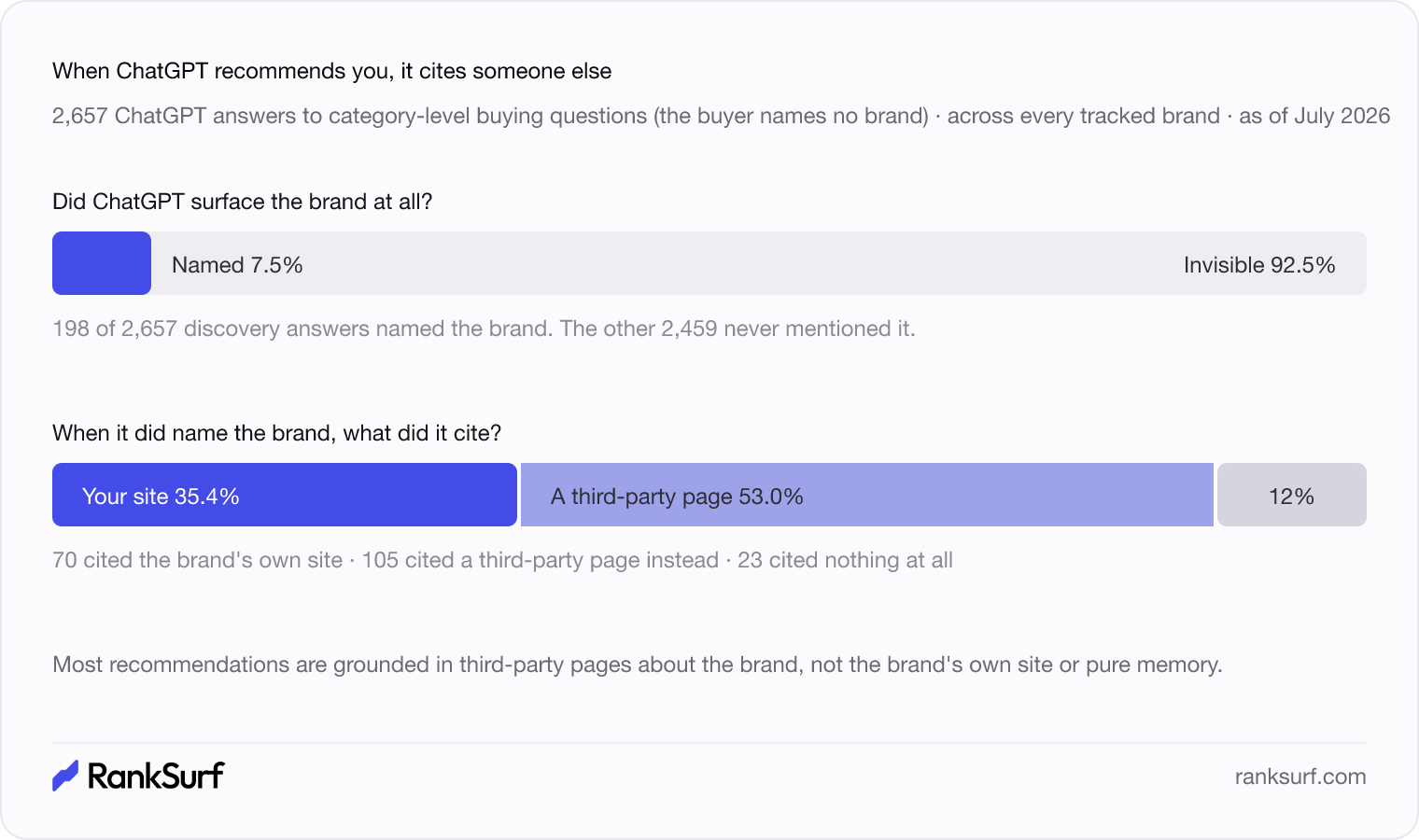
- Ask ChatGPT for the best tool in a category without naming a brand, and across 2,657 answers we tracked it surfaced the brand we monitor in just 7.5% of them (as of July 2026). Unprompted discovery is where you're most invisible.
- When ChatGPT did name a brand, it cited that brand's own site only 35% of the time. More often (53%) it cited a third-party page about the brand instead, and just 12% of the time it cited nothing at all. Recommendations are grounded in what others publish about you.
- That's the mechanism: ChatGPT builds recommendations from its trained-plus-retrieved picture of your category, and third-party pages feed both. Polishing your own pages alone can't move it.
- The lever is off-site presence: the Reddit threads, listicles, review sites, and comparisons ChatGPT already pulls from. Strong Google rankings don't carry over.
- Track 'named in the answer' and 'cited as a source' as two separate scores per engine, or the gap that's costing you deals stays hidden.
Ask ChatGPT to name the best tool in your category and it answers in a heartbeat: a tidy shortlist, no hesitation. The question that matters for your business is whether your brand made that list, and if it didn't, why a competitor did.
We pulled our own numbers to see how often that happens on its own. When a buyer asks ChatGPT a category question without naming any brand ("best tool for remote teams", "how do I fix X"), ChatGPT surfaced the brand we track in just 7.5% of 2,657 answers. More than nine times out of ten, the brand wasn't there at the moment a buyer was deciding. (Figures as of July 2026, across every project we track. These are brands whose teams run visibility scans, so the sample leans toward those who already suspect a gap; the direction holds either way.)
Then came the number that reset how we think about this. On the rare occasions ChatGPT did name a brand, it cited that brand's own website only 35% of the time. The rest of the time it was leaning on someone else's page about the brand, a Reddit thread, a review, a listicle, and only about one time in eight on nothing at all. The recommendation almost never came from the brand's own site.
That single fact changes the whole playbook for getting recommended, and it's why most "how to rank in ChatGPT" advice aims at the wrong target. This guide is about the recommendation itself, not just the citation. If you want the technical citation checklist (crawler access, schema, extractable structure), our complete guide to ranking in ChatGPT covers that layer in depth. Here we're one level up: how a brand becomes the name ChatGPT reaches for.
What does "recommended by ChatGPT" actually mean?
Being recommended means ChatGPT names your brand as an option when someone asks what to use. It's a different outcome from being mentioned in passing, and a different outcome again from being cited as a source.
These come apart more than you'd think. A brand can have its page quoted to build an answer and still watch ChatGPT recommend a competitor by name. We wrote a whole piece on that trap, cited but not recommended, after finding it in 29 of our tracked ChatGPT answers: your content does the work, a rival gets the customer. On buying-intent questions, being named is the win worth chasing. Being cited is a checkpoint on the way there, not the finish line.
So when this guide says "recommended," it means the practical thing: ChatGPT types your name in response to "what's the best tool for this."
Why doesn't ChatGPT just recommend the best product?
Because ChatGPT doesn't evaluate products. It predicts the answer that best fits what the web has taught it about your category, and your own website is a small part of that.
ChatGPT works from two places at once. There's its trained model of the world, built from the text it absorbed, and there's live retrieval, where ChatGPT search fetches current web results and attaches inline citations. The technical name for blending the two is retrieval-augmented generation: the model pulls in outside documents at answer time and mixes them with what it already knows. Our data shows where the weight actually sits. Of the answers that named a brand, 53% cited a third-party page about it, 35% cited the brand's own site, and only 12% cited nothing at all. The dominant source of a recommendation isn't your pages and it isn't raw memory. It's what other people published about you.
This is the reframe. You're not optimizing a page for a crawler. You're trying to become the brand the rest of the web brings up when the topic is your category. Polishing your own site helps ChatGPT quote you once it's already reaching for you. It does much less to make ChatGPT think of you in the first place.
Does ranking in Google get you recommended in ChatGPT?
No, and treating the two as the same job is the most expensive mistake here. Ranking #1 in Google means Google's algorithm picked your page. Getting recommended in ChatGPT means the model's trained sense of your category includes you as an answer.
The gap is real and measurable. Broad studies keep finding that most pages ChatGPT cites don't rank anywhere near the top of Google, and our own data shows the same disconnect from the other side: nearly two-thirds of the answers that named a brand cited a third-party page or nothing, not the brand's own site, so a strong Google page can't be the whole mechanism. Google skills still matter, because your pages have to be crawlable and quotable to get cited when retrieval does fire. They just aren't sufficient. You can own the SERP and stay invisible in the chat.
How do you actually get ChatGPT to recommend you?
You shape the consensus ChatGPT learned from, then make your own pages easy to quote when it checks the live web. In rough priority order, here's the work that moves the number.
1. Get into the third-party sources ChatGPT already trusts
ChatGPT builds its picture of your category from the places the web discusses it: Reddit threads, "best of" listicles, review sites, community answers. When we stripped brand-owned domains out of our citation data, Reddit was the single largest external source for every tool we studied, by a wide margin. The full breakdown is in our analysis of what AI answers actually cite. If your buyers compare tools in a subreddit and your name never comes up there, you've handed that citation to whoever does show up. Getting into those sources on purpose is its own discipline, and our off-site citation guide walks through the tactical version.
2. Make your own pages quotable and crawlable
This is the on-site layer, and it's table stakes, not a differentiator. Answer buying-intent questions directly, near the top of the page, in language a model can lift without rewriting. Keep your pricing, positioning, and category claims clear and current. Don't block the crawlers. None of this guarantees a recommendation, but it's what lets ChatGPT cite you cleanly on the roughly one-in-three occasions it does reach for your site, and it removes the dumbest reasons to be skipped.
3. Make your brand unambiguous as an entity
ChatGPT recommends brands it can pin down. Use one consistent name across your site, your profiles, and the places that write about you. State plainly what category you're in and who you're for. Earn comparisons and corroboration from sources beyond your own domain, because a claim repeated across the web by other people is exactly the kind of signal that both survives into training data and gets pulled at retrieval time. This is the slow compounding work, and it's what turns a brand from "sometimes cited" into "the name that comes up first."
4. Measure recommendation and citation as separate scores
Most tools report one blended visibility number, which hides the exact gap that's costing you deals. Track two things per engine: how often you're named in the answer, and how often you're cited as a source. When your citation rate climbs but your recommendation rate doesn't, you're in the cited-but-not-recommended trap and the fix is authority, not more content. This split is the core of how we built RankSurf's ChatGPT visibility tracking: named and cited are two columns, not one, because collapsing them buries the problem you actually need to solve.
How long until ChatGPT recommends you?
Longer than an SEO title change, shorter than a rebrand. Practitioners tracking this consistently report measurable citation gains within roughly 8 to 12 weeks of focused off-site work, with durable presence taking a few months to build. The reason is mechanical: you're waiting on the web's conversation about your category to shift, and for retrieval to start surfacing the new corroboration. It's not instant, and anyone promising a switch you can flip this week is selling the citation, not the recommendation.
The one thing to take away
Getting recommended by ChatGPT is a consensus problem wearing an SEO costume. Your own pages earn you the right to be quoted. The wider web, the reviews, the threads, the comparisons, decides whether ChatGPT names you when a buyer is actually choosing. Build the first, and you're cited. Build the second, and you're recommended.
You can see your own version of these numbers in a couple of minutes. Run a free AI visibility scan on your domain and watch how often ChatGPT names you, and how often it reaches for someone else instead.